

For decades, small developing countries have confronted an uncomfortable technological reality: by the time many transformative technologies become affordable and widely accessible, wealthier nations have already built enormous advantages around them.
Artificial intelligence may offer the Caribbean an opportunity to interrupt that pattern.
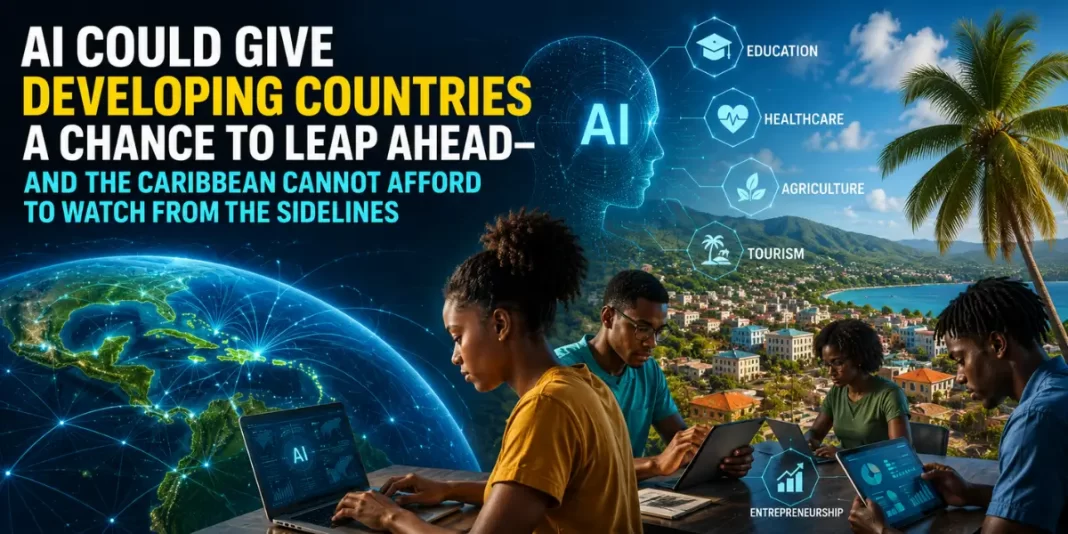
The emerging AI economy is not simply about building enormous data centers or creating the next global chatbot. Artificial intelligence is rapidly becoming a layer of infrastructure that can improve education, healthcare, agriculture, tourism, government services, business productivity and professional work.
That distinction matters enormously for small Caribbean economies.
A country does not need to manufacture computers to benefit from computers. It does not need to build smartphones to build businesses around smartphones. Similarly, Jamaica, Barbados, Trinidad and Tobago, Guyana and other Caribbean nations do not necessarily need to create frontier AI models to participate meaningfully in the AI revolution.
They need to determine where AI can multiply the value of the skills, industries and knowledge they already possess.
Consider tourism.
A small hotel could use AI to answer customer inquiries around the clock, translate communications into multiple languages, analyze guest feedback, develop marketing material and identify patterns in reservations.
A tour operator could use the technology to create customized itineraries based on a visitor’s interests.
A restaurant could analyze sales patterns and improve inventory decisions.
A farmer could eventually use AI-supported systems to identify crop diseases, analyze weather information and improve production planning.
Doctors and public-health professionals can use intelligent systems to help identify patterns in medical information. Teachers can develop personalized educational materials. Entrepreneurs can conduct research that once required teams of employees.
These are not futuristic possibilities reserved exclusively for multinational corporations.
Many of these capabilities already exist.
The larger question is whether Caribbean societies will organize themselves to use them productively.
Infrastructure remains a major part of that challenge. AI depends on electricity, internet connectivity, computing devices and digital skills. Communities without reliable access to those foundations can easily become excluded from the opportunities created by the technology.
This means an effective Caribbean AI strategy cannot begin and end with conferences about artificial intelligence.
It must include broadband, education and affordable access to technology.
Training is equally important.
The Caribbean should not simply teach people how to ask a chatbot questions. Workers need to understand how AI can be incorporated into specific professions.
An accountant should understand AI applications relevant to accounting. A journalist should understand AI-assisted research while maintaining editorial verification. A hotel manager should understand AI applications for hospitality. A farmer needs tools designed around agriculture rather than generic technology demonstrations.
This is where universities, community colleges, governments and private companies can play a transformative role.
Short, practical AI programmes could help existing professionals become considerably more productive without requiring them to return to school for several years.
There is another opportunity that receives far less attention: the human workforce behind AI itself.
Artificial-intelligence systems require enormous amounts of human evaluation, data preparation, cultural interpretation, language expertise, testing and quality control.
Caribbean workers possess cultural and linguistic knowledge that cannot simply be manufactured by an algorithm.
Caribbean English, Jamaican Patois, Haitian Creole, regional expressions, historical knowledge and cultural context all matter when intelligent systems are expected to operate effectively within Caribbean societies.
That creates the possibility of Caribbean businesses specializing in AI evaluation, regional datasets, cultural adaptation and digital knowledge services.
But the region must be careful not to become merely a source of inexpensive digital labor.
The objective should be to move upward in the value chain—from performing isolated tasks to owning companies, platforms, intellectual property and specialized expertise.
There are legitimate risks. AI can displace some work, accelerate misinformation and concentrate economic power in companies outside the region.
Ignoring AI, however, will not protect Caribbean workers from those changes.
It could simply ensure that other countries capture the opportunities while the Caribbean experiences only the disruptions.
The region has confronted technological transitions before.
This time, Caribbean governments and businesses have an opportunity to participate much earlier.
Artificial intelligence may ultimately become one of the most important productivity technologies of this century.
The Caribbean should not approach that revolution by asking whether AI is coming.
It is already here.
The question is whether the region will merely consume it—or learn how to build prosperity with it.