
From Build 9 to a Build 9+ Co-Developer Ecosystem
A Summary, Commentary & Implementation Response
By: Shannon Green | Entrepreneur, Mrs. Jamaica World
Inspired by and responding to the Jamaica Observer article
“Back to the blueprint: Slow uptake triggers NHT rethink of Build 9 housing programme”
Original reporting by Karena Bennett, Senior Business Reporter
Jamaica Observer | April 17, 2025
| Attribution Notice This document is an independent summary, commentary and proposed implementation framework written by Shannon Green. It does not reproduce the Jamaica Observer article. The original reporting and article remain credited to Karena Bennett and the Jamaica Observer. Readers are encouraged to read the complete original article at the source link provided below. |
Read the original Jamaica Observer article
1. Executive Perspective
The Jamaica Observer article raises an important question for Jamaica’s housing market: if contributors can pool their NHT benefits and the Build 9 framework already exists, why has the programme not produced communities at scale?
The answer suggested by the article is not that group development is a bad idea. The deeper problem is execution. Ordinary contributors are being asked to perform many of the functions of a professional developer: locate and secure suitable land, assemble a compatible group, coordinate surveyors and engineers, manage infrastructure, navigate approvals, control costs, splinter titles, arrange financing and move the project into construction.
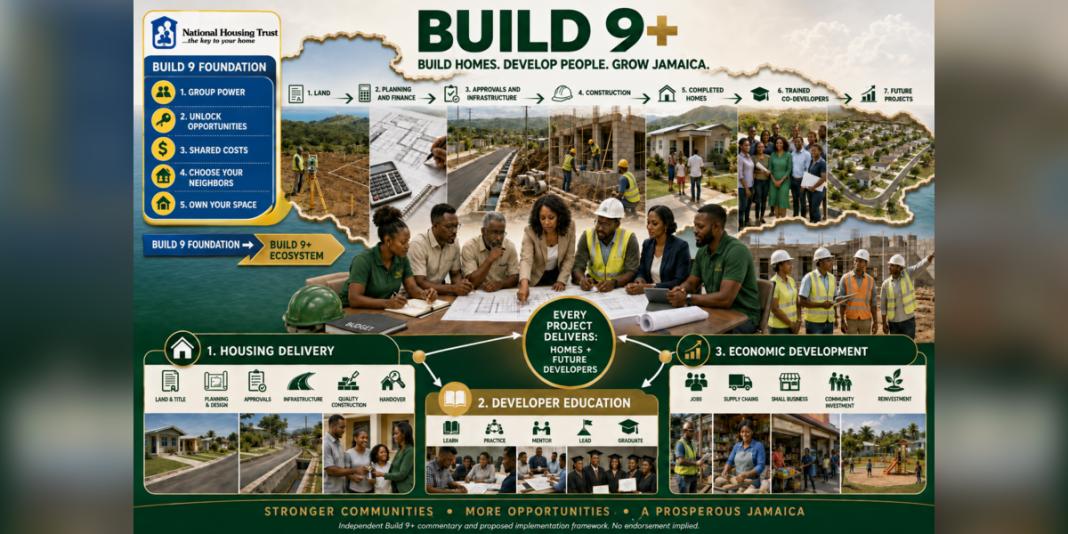
Build 9+ is a proposed response to that execution gap. It preserves the principle behind Build 9 people combining purchasing power to create housing while adding a structured co-developer and developer education ecosystem around the beneficiaries. It is designed not only to deliver homes, but to develop people into capable real estate developers who can participate in and lead future projects. The objective is to move participants from “a group trying to develop land” to “a professionally managed development group with a repeatable pathway from land to title to home and from participant to developer.”
The model rests on three foundational pillars: Housing Delivery build quality homes; Developer Education train competent developers through live project experience; and Economic Development create a self sustaining pipeline of future projects, businesses, jobs and investment. This changes the narrative from a housing programme into a national capacity building program.
2. What the Jamaica Observer Article Tells Us
A strong concept, limited delivery: Build 9 began as the Cluster Housing Programme and was designed to allow contributors to pool benefits to purchase land, install infrastructure, subdivide lots and ultimately construct individual homes. The Observer reports that uptake and completion have remained limited despite the longevity of the programme.
Infrastructure is the major pressure point: Roads, drainage, water, sewerage and related works are expensive, technical and often must be completed before individual titles and construction can proceed. This creates a financing and sequencing challenge.
Professional coordination is costly: Surveying, engineering, legal work, subdivision, project management and approvals all require specialist input. These costs can arise before contributors are in a position to build their homes.
The beneficiaries carry developer-level responsibility: The article highlights a structural mismatch: contributors may be eligible and motivated homebuyers, but they are not necessarily trained developers. Yet the coordination burden remains largely with the group.
Affordability makes the idea more relevant, not less: Jamaica’s housing shortage and escalating open-market prices make cooperative and group-led models increasingly important. The challenge is converting eligibility and interest into completed, titled and financeable housing.
The programme needs a delivery mechanism: The policy can provide a framework and financing support, but a practical operating system is required to source projects, assemble teams, manage approvals, fund infrastructure and deliver homes consistently.
3. The Missing Layer: From Build 9 to Build 9+
Build 9+ is conceived as an implementation and learning ecosystem, not a replacement for the NHT programme. Its purpose is to add both the professional development infrastructure and the developer education pathway that a contributor group cannot reasonably be expected to create for itself. Professional specialists continue to carry regulated and technical responsibilities, while participants learn how each discipline fits into the complete development cycle.
4. The Missing Layer: Developer Education & Capacity Building
Traditional housing programmes deliver houses. Build 9+ is designed to deliver houses and developers. Every participant becomes an active learner throughout the project, gaining practical exposure to land acquisition, planning, feasibility, financing, approvals, infrastructure, procurement, construction, governance and project close-out. The project itself becomes the classroom.
Participants attend site meetings, planning sessions, budgeting workshops, lender presentations, subdivision reviews, construction inspections and project close-outs. They finish the programme understanding not only what happened, but why each decision was made, what alternatives were considered, what risks were controlled and what evidence supported the final course of action.
| Two Deliverables from Every Build 9+ Project 1. A completed housing development. 2. A graduating group of trained co-developers equipped to participate in or lead future developments. |
| Area | Build 9 Execution Challenge | Build 9+ Co-Developer Response |
| Land | Participants must find suitable land and negotiate it. | A central co-developer platform identifies, evaluates, controls or acquires suitable land before the group carries the full burden. |
| Group formation | Individuals must organize themselves and stay aligned. | Participants are assembled around a defined project, budget, eligibility profile, governance structure and documented commitments. |
| Technical team | Each group must locate and coordinate professionals. | A repeatable panel of surveyors, planners, engineers, quantity surveyors, attorneys, architects and contractors is coordinated through the ecosystem. |
| Approvals | The group navigates a fragmented approval process. | A dedicated development-management function tracks submissions, conditions, timelines and dependencies. |
| Infrastructure | Funding and managing roads, drainage and utilities can stall the project. | Infrastructure is budgeted early, phased where practical and supported by a blended capital plan rather than treated as an afterthought. |
| Project management | Beneficiaries effectively become amateur developers. | The co-developer takes responsibility for programme management, reporting, procurement, risk controls and milestone accountability. |
| Construction | Individual construction can become fragmented and expensive. | Standardized designs, bulk procurement and coordinated construction can reduce duplication and improve cost control while preserving defined buyer choices. |
| Exit to ownership | Titles and mortgage readiness may arrive late or unpredictably. | The process is designed backward from title, financing and occupancy requirements, with documentation and compliance built into each stage. |
| Developer education | Participants may complete a project without understanding why key development decisions were made. | Every phase includes structured learning, practical exposure, documented reflection and competency milestones so participants graduate as capable future co-developers. |
5. The Land First Advantage
One of the most important improvements in the Build 9+ model is to reverse the usual starting point. Instead of forming a group first and then asking the group to search for land, the ecosystem can begin with land that has already been identified, screened and placed under an appropriate form of control, subject to legal, planning, technical and financial due diligence.
This changes the conversation with participants. They are no longer joining an abstract housing idea. They can evaluate a defined location, preliminary yield, target lot or unit type, infrastructure assumptions, projected development budget, timeline and participation structure.
A land-first approach does not eliminate development risk. Planning permission, subdivision, infrastructure, environmental conditions, title matters, cost escalation and financing still require disciplined due diligence. What it does is remove one of the largest sources of uncertainty and allows the professional team to test feasibility before the wider group is fully committed.
6. How the Build 9+ Co-Developer & Developer Education Ecosystem Works
1. Land Origination & Control
Delivery milestone: Source land; review title, access, planning context and value; complete preliminary technical screening; and negotiate purchase, option, joint venture or another suitable control structure.
Learning milestone: Participants learn how land is sourced, screened, valued, controlled and rejected when material risks cannot be resolved.
2. Feasibility & Development Blueprint
Delivery milestone: Prepare the preliminary concept, density/yield, infrastructure scope, high-level cost plan, development schedule, risk register and financing requirement.
Learning milestone: Participants work through a feasibility workshop and learn how yield, cost, timing, market demand and risk determine whether a project should proceed.
3. Participant Qualification & Group Formation
Delivery milestone: Identify suitable contributors, confirm NHT and mortgage readiness where applicable, explain obligations, and establish deposits, participation rules and governance.
Learning milestone: Participants learn group governance, disclosure, decision rights, financial readiness, conflict management and the obligations of co-development.
4. Professional Team Mobilization
Delivery milestone: Coordinate legal, surveying, planning, engineering, architecture, quantity surveying, environmental and project-management resources.
Learning milestone: Participants meet the professional team, review scopes and deliverables, and learn how to procure, brief, coordinate and evaluate specialist advice.
5. Capital Stack & Infrastructure Funding
Delivery milestone: Map participant equity and deposits, eligible NHT benefits, mortgage proceeds, landowner terms, private or institutional capital, bridge funding and other compliant sources.
Learning milestone: Participants build and test the capital stack, examine lender requirements and practise presenting the project’s financing case.
6. Approvals, Subdivision & Infrastructure
Delivery milestone: Manage approvals; satisfy conditions; procure and supervise roads, drainage, water, utilities and other works; and maintain cost and milestone reporting.
Learning milestone: Participants review applications, subdivision plans and conditions; attend selected inspections; and learn how approvals, infrastructure and sequencing affect risk and value.
7. Title & Mortgage Readiness
Delivery milestone: Coordinate splinter titles or other approved ownership documentation, valuations, lender requirements and participant closing readiness.
Learning milestone: Participants study the title and closing pathway and learn how legal documentation, valuation, security and underwriting convert a development into financeable ownership.
8. Home Design & Construction
Delivery milestone: Deploy approved home designs or defined customization bands; aggregate procurement where feasible; and manage contractors, quality, change orders and progress certification.
Learning milestone: Participants review drawings, budgets, tenders, site reports and change controls and attend construction inspections focused on quality, cost and schedule.
9. Handover & Community Formation
Delivery milestone: Complete inspections, handover, homeowner documentation, common-area arrangements and community governance where applicable.
Learning milestone: Participants take part in defects review, handover and close-out and learn how warranties, records, governance and resident stewardship protect long-term value.
10. Replication & Scale
Delivery milestone: Capture cost, approval, contractor, financing and delivery data so the next Build 9+ community is faster, more predictable and easier to finance.
Learning milestone: Participants complete a capstone review, document lessons learned, demonstrate competency and prepare a pathway to participate in or lead a future development.
7. CREDCAD-SD™ Learning Framework
The educational backbone of Build 9+ is the CREDCAD-SD™ Learning Framework: a structured 12 month, 10 phase professional development program built around real projects rather than classroom theory. Learning is synchronized with project execution so that every major development stage produces both a physical milestone and an educational milestone.
The framework combines guided workshops, live meetings, site exposure, document reviews, applied assignments, professional mentoring, phase assessments, reflective learning records and a final capstone. Completion should be based on demonstrated participation and competency, not attendance alone. The intended outcome is a participant who can evaluate opportunities, work responsibly with licensed professionals, understand project economics and governance, and contribute meaningfully to the leadership of a future development.
8. Who Does What?
| Participant | Primary Role |
| Participants / Homeowners / Learners | Provide required equity or deposits; maintain eligibility and financing readiness; approve defined group decisions; meet contractual obligations; complete learning milestones; attend required project and site sessions; maintain a learning record; and prepare to participate in or lead future developments. |
| Build 9+ Co-Developer | Originates and structures the project; coordinates professionals; manages programme, budget, schedule, procurement, reporting, risks and participant communication. |
| Landowner / Development Partner | Provides or sells land under negotiated terms and satisfies agreed closing or development obligations. |
| NHT / Mortgage Lenders | Provide eligible housing finance and apply their underwriting, valuation, security and disbursement requirements. |
| Professional Consultants | Design, certify, survey, plan, value, cost, advise and secure approvals within their respective professional mandates. |
| Contractors & Suppliers | Deliver infrastructure and building works under documented scopes, budgets, quality standards and payment controls. |
| Capital Partners | Where required and legally permitted, provide appropriately structured capital for land, infrastructure, bridging or construction subject to formal investment and security documentation. |
9. Why This Could Improve the Original Build 9 Model
- Execution becomes institutional rather than improvised: The process belongs to a repeatable operating platform instead of being reinvented by every group.
- Land can be matched to people, not merely people to an idea: A defined project improves transparency, budgeting and decision-making.
- Professional costs can be planned and shared: Rather than surprise expenses, development services can be scoped and incorporated into the project budget from the beginning.
- Infrastructure can be financed as a project requirement: The model treats enabling works as a core development phase requiring dedicated capital, controls and milestones.
- Group buying creates leverage: Where scale permits, design standardization, bulk procurement, coordinated construction and professional fee negotiations may improve economics.
- Accountability is visible: Dashboards, stage gates, budgets, variance reports, documented approvals and named owners make delays and cost overruns easier to identify and manage.
- The model can produce data: Each project can create evidence on true infrastructure costs, approval timelines, buyer affordability, contractor performance and financing gaps precisely the information needed to improve housing policy and future projects.
- Every project becomes a classroom: Participants learn through real decisions, real documents, real risks and real accountability instead of observing development from a distance.
- Capacity compounds: Every graduating group increases Jamaica’s stock of experienced co-developers, creating a pipeline of people capable of building the next hundred homes and the projects that follow.
10. A Practical Pilot: Start Where the Land Already Exists
The fastest way to test Build 9+ is not to begin with a national rollout. It is to select a controlled pilot site where the land position is sufficiently advanced to permit meaningful feasibility work.
The pilot should establish a complete development file: title and legal due diligence, planning review, preliminary subdivision or site concept, infrastructure design assumptions, quantity-surveyor cost plan, professional-fee budget, financing map, participant criteria, governance documents, development schedule and risk register.
The first pilot should then be measured against clear outcomes: cost per serviced lot or unit; time to approvals, infrastructure cost as a percentage of total development cost, participant affordability, financing gap, time from group formation to title readiness, construction cost per square foot, actual versus budget variance, learning milestone completion, demonstrated participant competency, graduation rate, and the number of graduates who enter or lead a subsequent project.
That evidence can then support a serious conversation with NHT, lenders, landowners, public agencies, professional bodies, institutional investors and diaspora capital about what would be required to replicate the model responsibly.
11. Governance and Safeguards
Build 9+ should be designed with strong governance from the beginning. Group development involves people’s deposits, housing benefits, land rights and long-term financial obligations. The platform therefore needs controls equal to the trust being placed in it.
- Independent legal documentation for land control, participant rights, project entities and security arrangements.
- Segregated project accounting and clear rules governing the custody and permitted use of participant funds.
- Written budgets, procurement controls, competitive quotations where appropriate, and documented change-order procedures.
- Stage-gate approvals before material funds are committed to the next development phase.
- Regular participant reporting covering schedule, budget, approvals, risks and next actions.
- Qualified professionals carrying appropriate licences, insurance and defined scopes of work.
- Clear disclosure that preliminary concepts, costs and timelines remain subject to approvals, due diligence, market conditions and financing.
- Compliance review for any capital-raising or investment component, including securities, mortgage, trust, consumer-protection and anti-money-laundering requirements that may apply.
- A documented education standard covering required learning activities, attendance, assessments, mentoring, competency evidence, graduation criteria and appropriate limits on participants performing regulated professional work.
12. Measuring Success: Homes Built and Developers Developed
Housing outputs remain essential, but they are only half of the Build 9+ scorecard. Success should be measured across the three pillars: homes and serviced lots delivered; participants trained and competencies demonstrated; and the economic pipeline created through new projects, businesses, jobs, investment and repeat participation.
Humans naturally count houses because houses are visible. The harder and ultimately more valuable metric is how many people leave the programme capable of helping to build the next hundred houses. That is the multiplier effect: each completed project expands both Jamaica’s housing stock and its stock of experienced developers.
13. Conclusion: Keep the Blueprint, Upgrade the Delivery System
The central lesson from the Jamaica Observer article is that Jamaica does not necessarily need to abandon the Build 9 concept. It needs to solve the practical gap between a housing policy and a completed development, and the deeper gap between people who want housing and people equipped to organize its delivery.
Build 9+ proposes that beneficiaries should not be left to become developers by accident. They should be supported by a professional co-developer ecosystem and deliberately educated through the full project cycle. Viable land, disciplined feasibility, coordinated professionals, infrastructure finance, approvals, construction, transparent governance and applied learning become one integrated pathway from land to ownership and from participant to capable co-developer.
The opportunity is larger than a single development. If a properly governed model can demonstrate that groups of Jamaicans at home and across the diaspora can combine resources, professional capability and structured developer education, Build 9 can evolve from an underused programme into a scalable national platform for community ownership, housing production and economic development. The true legacy of Build 9+ will not be merely the homes built today, but the developers who will build tomorrow.
Source, Credit & Use Note
Original article: “Back to the blueprint: Slow uptake triggers NHT rethink of Build 9 housing programme.”
Author: Karena Bennett, Senior Business Reporter.
Publication: Jamaica Observer, Caribbean Business Report.
Published: April 17, 2025.
Source: Jamaica Observer original article