
For generations, Caribbean destinations have competed with one another using some of the world’s most powerful tourism assets: warm weather, beautiful beaches, distinctive cultures, music, cuisine and hospitality.
Those advantages remain formidable.
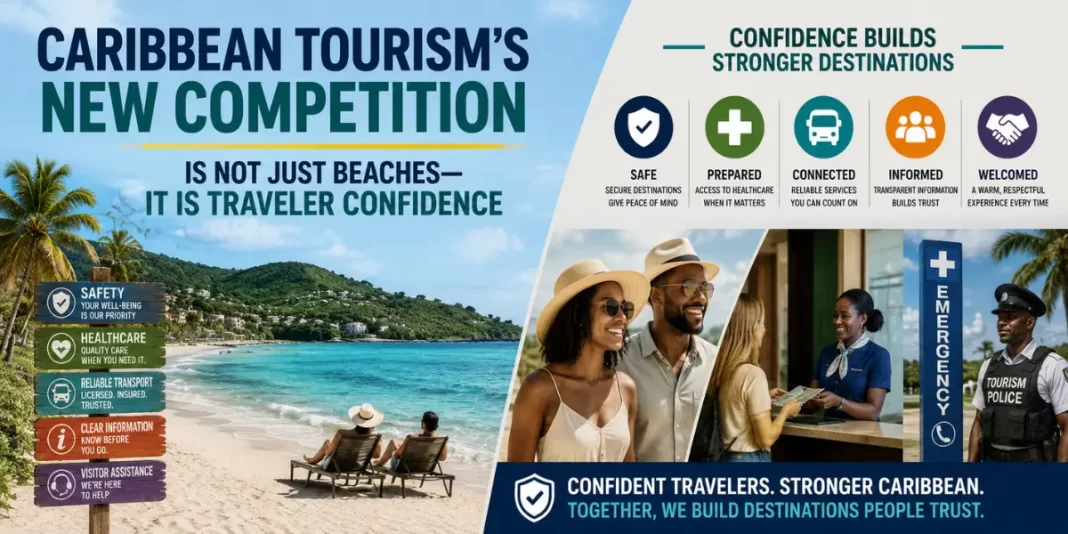
But modern travelers are increasingly evaluating another commodity before purchasing an airline ticket: confidence.
They want to know whether they will feel safe. They want reliable transportation. They want access to healthcare if something goes wrong. They want functioning infrastructure, accurate information and confidence that the vacation shown in advertising resembles the experience awaiting them on arrival.
That means public safety and tourism marketing can no longer operate as separate conversations.
Recent international travel guidance illustrates the challenge. Caribbean destinations can receive substantially different assessments based on crime, healthcare, infrastructure and other risks. Jamaica, for example, currently carries advice for travelers to exercise increased caution, with particular communities identified as higher-risk locations.
The important point for the tourism industry is not to debate whether every foreign assessment perfectly reflects local conditions.
The important point is that travelers read them.
Travel agents read them.
Families read them.
Insurance companies consider them.
Corporate travel departments may consider them.
A perception created thousands of miles away can therefore affect a hotel room, restaurant table or tour booking in the Caribbean.
That creates both a challenge and an opportunity.
Caribbean governments should recognize tourism security as an economic investment rather than merely a policing expense.
Well-lit tourism districts, reliable emergency response, professionally regulated transportation, visible but appropriate security, clean public areas and strong visitor-assistance systems contribute directly to destination competitiveness.
Healthcare is part of the equation as well.
An older traveler considering a Caribbean vacation may care as much about access to emergency medical treatment as proximity to the beach. Families traveling with children may ask similar questions.
Destinations that can confidently communicate their emergency capabilities gain another competitive advantage.
The private sector also has a role.
Hotels, villas, attractions and transportation companies should provide guests with accurate information rather than pretending risks do not exist.
Visitors appreciate knowing which transportation providers are legitimate, which areas require additional caution and whom to contact in an emergency.
Good information does not frighten travelers.
Uncertainty does.
The Caribbean must also distinguish between isolated high-risk communities and entire destinations. A traveler unfamiliar with Caribbean geography can easily read the name of a parish or district and assume that the warning describes the whole country.
Tourism authorities therefore need sophisticated communication strategies that explain geography clearly without minimizing genuine safety concerns.
Jamaica provides a particularly important case study.
The country possesses one of the strongest tourism brands in the Caribbean. Its music, cuisine, athletes and cultural influence give Jamaica recognition far beyond what would normally be expected of a nation its size.
That brand is economically valuable.
Protecting it requires acknowledging that every widely reported crime involving a visitor can travel internationally within minutes.
The tourism industry consequently has a direct interest in broader improvements in public safety.
The same principle applies across the region.
Travelers have more choices than ever. A person considering Jamaica can also consider Barbados, Aruba, St. Lucia, the Dominican Republic, Mexico, Central America or dozens of destinations outside the Caribbean.
Beautiful water alone does not guarantee the booking.
Price matters.
Air access matters.
Service matters.
And confidence matters.
The Caribbean therefore needs to think about destination security as part of the tourism product itself.
Imagine a regional tourism strategy where visitors receive seamless verified transportation from the airport, emergency information through their phones, clearly identified tourism zones, rapid assistance when problems occur and reliable medical support when necessary.
Those improvements benefit residents as much as visitors.
That is perhaps the most important point.
A safer tourism destination should also mean safer communities for the people who live there.
Tourism cannot exist permanently as an island separated from society around it.
The strongest destinations will ultimately be places where visitors feel comfortable because residents themselves live within functioning, secure and well-managed communities.
The Caribbean has already mastered selling paradise.
The next competitive advantage may be proving that paradise is also a place travelers can trust.