

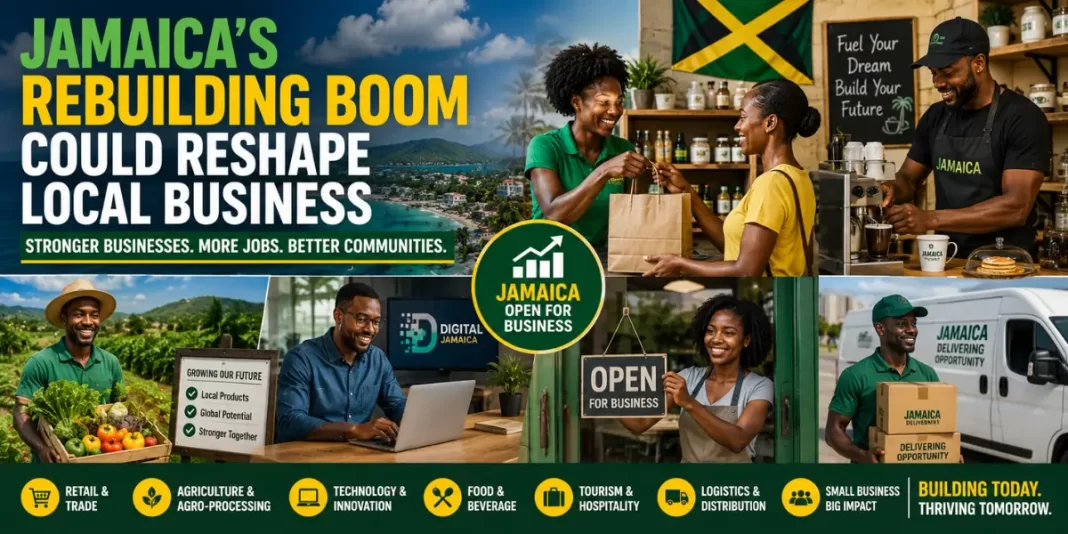
Jamaica’s reconstruction period is creating more than a national recovery challenge. It is also creating one of the most significant business opportunities the country has seen in years.
Large-scale rebuilding affects nearly every major sector of the economy. Construction companies need cement, steel, lumber, equipment and skilled workers. Hotels and tourism businesses need repairs, furnishings, technology and reopened supply chains. Government agencies require engineering, transportation, logistics and professional services. Communities need homes, shops, schools, healthcare facilities and infrastructure restored.
That means reconstruction spending does not remain confined to construction sites.
It moves through the wider economy.
A contractor wins a project and purchases materials. A supplier hires more staff. Trucking companies move goods. Restaurants serve workers. Accountants manage larger business volumes. Insurance companies process claims. Technology companies supply equipment and software. Banks finance expansion.
One rebuilding project can therefore create economic activity far beyond the project itself.
For Jamaican entrepreneurs, the critical question is whether local businesses are prepared to capture enough of that activity.
Large international reconstruction programmes often attract multinational contractors because they possess experience, capital and technical capacity. That can be necessary for specialized projects, but Jamaica should avoid a situation where local companies become spectators while most of the economic value flows outward.
The country has an opportunity to use reconstruction as a business-development strategy.
Small and medium-sized Jamaican companies can be encouraged to form partnerships, develop specialized skills, improve standards and participate in larger procurement opportunities.
A local electrical contractor that gains experience working on resilient infrastructure could later compete for projects elsewhere in the Caribbean. A Jamaican engineering company that develops expertise in hurricane-resistant design could export that knowledge. A construction supplier that expands production during the rebuilding period could emerge as a stronger regional company.
This is how reconstruction becomes economic transformation rather than temporary activity.
Access to financing will be one of the biggest obstacles.
Many Jamaican businesses can perform work but lack the cash flow required to purchase materials, hire additional workers or wait months for payment on large contracts.
Banks and development institutions therefore have an important role.
Special reconstruction financing programmes could allow credible local companies to expand specifically to participate in rebuilding projects. The financing should reward businesses that demonstrate proper accounting, tax compliance, safety standards and the ability to complete projects.
That approach would strengthen the formal economy while increasing local participation.
Training is equally important.
Jamaica will need skilled tradespeople, engineers, technicians, project managers, renewable-energy specialists and construction professionals.
Rebuilding provides an ideal opportunity to expand technical education.
Young Jamaicans entering the labor force should be able to see reconstruction not only as temporary work but as a pathway into skilled careers.
Apprenticeships could connect young workers with companies receiving large contracts. Those workers would earn income while developing skills that remain valuable long after reconstruction ends.
The rebuilding period also gives Jamaica an opportunity to encourage innovation.
New homes and commercial properties can incorporate solar energy, water storage, stronger roofing systems, improved drainage and smart-building technologies.
Local businesses that specialize in these areas could grow rapidly.
Reconstruction should not simply restore yesterday’s economy.
It can help build tomorrow’s businesses.
There is also an important Diaspora opportunity.
Jamaicans living abroad possess capital, professional experience, business networks and technical expertise. Many want to participate in Jamaica’s development but often lack clear pathways.
A structured reconstruction investment platform could connect Diaspora investors with vetted Jamaican projects and businesses.
That would transform emotional support for Jamaica into productive economic participation.
Transparency will determine whether these opportunities produce lasting confidence.
Businesses need clear procurement rules. Citizens need to understand how major contracts are awarded. Investors need confidence that projects are legitimate.
The stronger the transparency, the greater the willingness of local and international investors to participate.
Jamaica is rebuilding because it must.
But how the country rebuilds will determine whether the economic effect lasts for years or only for the duration of construction.
The most successful outcome would be a Jamaica that emerges with stronger roads and buildings, but also stronger companies, better-trained workers and a deeper pool of local expertise.
That would mean reconstruction did more than repair damage.
It helped build a more capable Jamaican economy.