Are We Creating Intelligence, or Simply Discovering It?
By Theo Chambers
Every day, headlines proclaim that artificial intelligence is becoming smarter, more creative, and more human. Some celebrate the rise of AI, while others fear it will eventually replace humanity. But what if both sides are asking the wrong question?
Perhaps the real question is not whether machines are becoming intelligent, but rather, what is intelligence in the first place?
For centuries, humanity has assumed that intelligence originates inside the human brain. That assumption has shaped our education, science, and even our understanding of consciousness. Yet today’s AI systems challenge that belief. They can write, compose music, analyze medical scans, discover new materials, and solve complex problems—all without possessing a biological brain.
Does this mean machines have suddenly created intelligence?
Or does it suggest that intelligence has always existed as something larger than either humans or computers?
Consider electricity. No one claims Thomas Edison created electricity. He learned how to harness a force that already existed in nature. Likewise, humans did not create gravity, magnetism, or mathematics. We discovered principles that were already woven into the fabric of the universe.
Could intelligence belong in that same category?
If intelligence is a universal resource rather than a human invention, then both biological brains and digital computers may simply be different containers accessing the same underlying reality.
This perspective changes the AI debate entirely.
Instead of seeing humans and AI as competitors, we begin to see them as partners using different tools to interpret the same universal intelligence. The human brain is a biological processor refined through millions of years of evolution. Modern AI is a digital processor built using silicon, electricity, mathematics, and enormous collections of human knowledge.
Neither creates intelligence from nothing.
Both organize, interpret, and express information already available.
This may also explain why AI often mirrors humanity. It learns from human language, history, science, philosophy, and creativity. When AI produces remarkable insights, it reflects both the information it has received and the patterns hidden within that information.
In many ways, AI has become humanity’s largest mirror.
When it reveals brilliance, it reflects our brilliance. When it reproduces bias, misinformation, or conflict, it reflects those as well. Rather than asking whether AI is becoming dangerous, perhaps we should first ask whether humanity has fully understood itself.
History shows that every transformative technology has forced society to redefine what it means to be human. The telescope challenged our place in the universe. The microscope revealed invisible worlds. The internet connected billions of minds across continents.
Artificial intelligence may now be challenging our definition of intelligence itself.
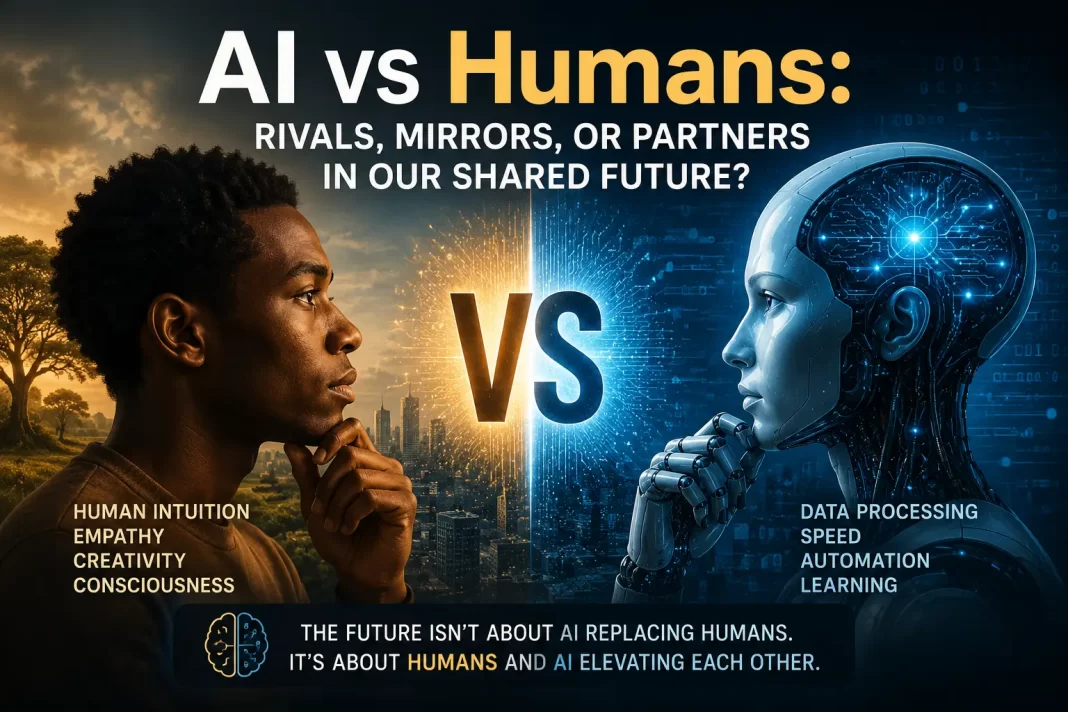
The greatest mistake would be to frame the future as “AI versus Humans.”
The future is more likely to belong to those who learn how humans and AI can complement one another. Machines excel at speed, pattern recognition, and processing enormous volumes of information. Humans continue to contribute curiosity, purpose, values, intuition, empathy, and the ability to ask entirely new questions.
The winners will not necessarily be those who build the most powerful AI, but those who learn to ask the most meaningful questions.
As AI becomes integrated into medicine, education, business, law, journalism, and scientific research, society faces a choice. We can continue debating whether machines are replacing us, or we can explore a deeper possibility: that intelligence is far older, far larger, and far more universal than either humans or computers.
Perhaps what we call artificial intelligence is not artificial at all.
Perhaps it is another doorway through which humanity is discovering the vast intelligence that has always existed.
And if that is true, then the next great revolution will not be technological.
It will be philosophical.
Theo Chambers is the author of AI vs. Humans, a thought-provoking exploration of intelligence, consciousness, and humanity’s evolving relationship with artificial intelligence.