
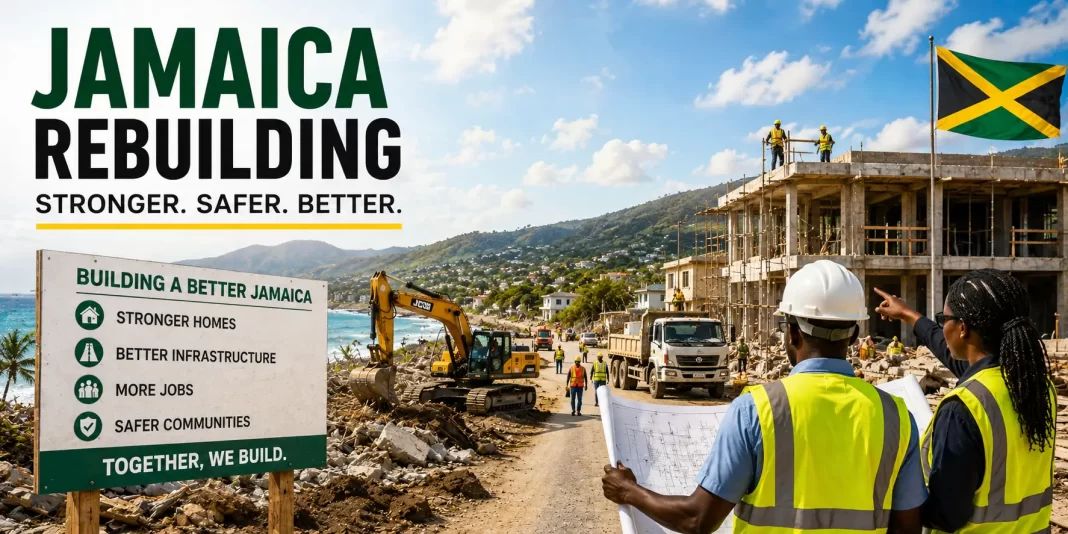
Jamaica has entered a stage of national recovery in which the conversation can no longer focus exclusively on what Hurricane Melissa destroyed. The larger question is what Jamaica will build in its place.
The country faces one of the most consequential reconstruction periods in its modern history. Billions of dollars in international financing, domestic resources and prospective private investment have been mobilized or identified for rebuilding. Roads, housing, tourism infrastructure, public facilities, utilities, businesses and entire communities require varying degrees of repair, reconstruction or modernization.
That enormous undertaking creates opportunity, but it also creates an equally enormous responsibility for government.
During the immediate aftermath of a natural disaster, citizens generally judge leadership by emergency response. They want electricity restored, roads cleared, water flowing, shelters functioning and assistance reaching affected families. As the emergency phase recedes, however, public expectations change. People begin asking different questions.
When will my community be rebuilt? When will damaged infrastructure be permanently repaired? Where is the reconstruction money going? Which projects have been approved? Who received the contracts? When will the work be completed?
Those questions transform disaster recovery into a test of governance.
For Jamaica, the challenge is particularly significant because reconstruction is not simply about replacing what existed before Hurricane Melissa. Rebuilding damaged structures exactly as they were could recreate the same vulnerabilities that existed before the storm.
The country instead has an opportunity to rethink how roads, drainage systems, homes, schools, hospitals, utilities and commercial developments are constructed.
A road repeatedly destroyed by flooding should not merely be resurfaced. The drainage problem that causes the flooding must also be addressed. A community that repeatedly loses electricity after major storms should become part of a broader discussion about resilient energy systems. Homes rebuilt in vulnerable locations should incorporate stronger construction practices wherever practical.
In other words, reconstruction should become modernization.
That distinction could determine whether billions of dollars produce temporary repairs or generational improvements.
There is also an important economic dimension. Large reconstruction programmes create contracts and employment across construction, engineering, transportation, technology, architecture, logistics and professional services. Jamaican businesses should be positioned to participate meaningfully in that economic activity.
If billions are spent rebuilding Jamaica while an excessive portion of the economic benefit leaves Jamaica, an extraordinary opportunity for domestic business development will have been lost.
This is where transparency becomes critical.
Large amounts of reconstruction money inevitably attract political scrutiny. Citizens should be able to understand which projects are being funded, what they cost, who receives major contracts and whether projects are being completed according to schedule.
Transparency should not be treated as an inconvenience imposed on reconstruction. It can become one of the government’s greatest assets.
When citizens can see progress and understand how money is being spent, public confidence grows. When information is difficult to obtain, suspicion fills the vacuum.
Technology gives Jamaica an opportunity to make this recovery unusually transparent. A public digital reconstruction dashboard could show major projects, locations, budgets, contractors, expected completion dates and current progress.
Imagine a Jamaican being able to open a website, select a parish and immediately see the reconstruction projects underway in that area.
That would transform accountability from an occasional parliamentary debate into something citizens could observe themselves.
The recovery also presents a political challenge that crosses party lines. Hurricanes do not distinguish between government and opposition constituencies. Reconstruction therefore must be visibly national.
Communities should believe that projects are prioritized according to damage, economic importance, safety and public need rather than political affiliation.
If Jamaica succeeds, Hurricane Melissa could eventually be remembered not only for destruction but as the catalyst for building stronger national infrastructure.
If the process becomes burdened by delays, questionable procurement, uneven development or poor communication, the enormous financial commitment will become a source of political frustration.
That is why the reconstruction period may become one of the defining tests of government delivery.
Announcements will matter less as time passes.
What citizens will eventually remember is what was actually built.